Blindness Was The Secret That Weighed Her Down

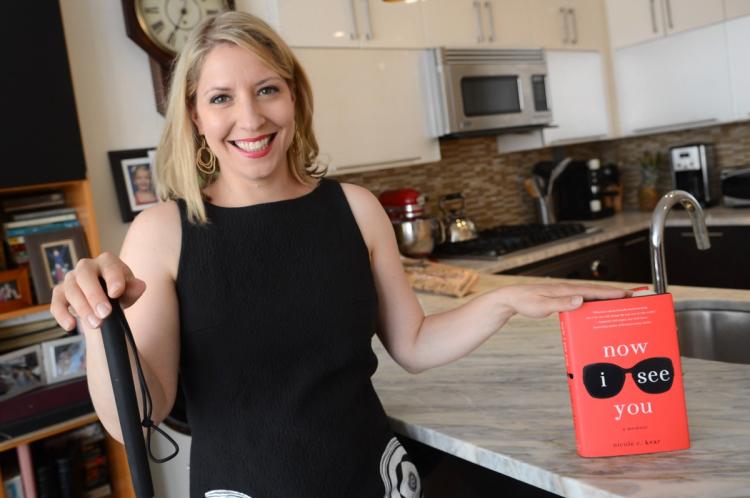
Two-Minute Memoir: Hiding in Plain Sight | By Nicole C. Kear, Author of the book, Now I See You

*Originally posted May 6, 2014 on Psychology today

As soon as I started going blind, I resolved to keep it to myself.

In the beginning, my blindness wasn’t a secret; it was a detail I chose not to divulge. The difference seemed simple and clear to me. A lot of things seemed simple and clear when I was 19.

I found out the summer after my sophomore year in college that I was losing my vision, thanks to an incurable degenerative retinal disease called retinitis pigmentosa. As I sat stunned in the vinyl examination chair, a doctor explained that first I’d lose my peripheral and nighttime vision, then my central acuity, too. It was impossible to guess how long it would take, but with a little luck, he said, I might make it to 30, maybe 35, before I was blind.

I shared the news with close friends and family and the conversations went well enough until they asked what medicine I’d take. As soon as they heard that there was no treatment, no operation, the mood turned somber. Losing my vision was bad enough, but the tears and lucky charms and awkward inspirational speeches were unbearable. I hated the idea that this tragic flaw would become my defining characteristic; I was young and vivacious and about to earn an Ivy League diploma. I wanted to write my own life story.

So I stopped telling people about it. I didn’t look impaired—and wouldn’t for a long time—so they wouldn’t know unless I pointed it out. It was medical information, I told myself, and I had a right to keep it private. Besides, there was no time to waste with tears and self-pity: I had to live as though there were no tomorrow.

I wasn’t lying, at least as I reasoned it. Lies were statements that were patently untrue, stories you made up, like when I told my mother that I was sleeping over at my friend Miriam’s house and instead spent the night at my boyfriend’s. This was different: just me not correcting an assumption people made—that I was fully sighted—because it was more trouble than it was worth to explain; it was akin to not correcting customer service reps who mispronounced my name.

After college, I moved back to my native New York to start an acting career. My vision loss caused problems only in dimly lit places, where the dark was more dense, more absolute for me than for other people, like wearing sunglasses at night. During blackouts in the plays I performed in, I often ended up lost, tangled in backdrops or banged up after tripping over set pieces. When castmates noticed, I laughed it off, pleading clumsiness or making a blonde joke at my own expense.

Going out to bars and restaurants was tricky, too. I frequently fell down stairs or mistakenly walked into men’s bathrooms. Thankfully, there were few low-light social situations that didn’t involve alcohol, and alcohol could explain away a lot of stumbling. Still, it wasn’t really a lie, I told myself; I was just accentuating one part of the picture, like wearing makeup or a push-up bra.

At 24, I moved to Hollywood to try to break into film and TV. There, my hidden blindness was just one more untruth in a fleet of white lies, from my weight to my age to my natural hair color. My fiancé, who’d come to L.A. with me, knew the whole truth, of course—he had taken it in stride from the moment I told him. But even that confession was years in the making and prompted only by the realization that I could have lost him had I kept him at arm’s length. He’d raise an eyebrow when he overheard my fabrications, like telling friends I needed a ride because my car was broken—in reality, I couldn’t drive at night—but the upside of my tunnel vision was that I didn’t have to see his disapproval if I didn’t want to.

We soon moved back to New York, where, as I got older, the aperture of my vision closed in more tightly. I developed color blindness and cataracts that couldn’t be removed. And while my blindness evolved, so did my cover stories. I didn’t text on my phone because I couldn’t make out the print, but I told people it was because I preferred talking. When I became pregnant at 27, years before any of my peers, I explained that I really wanted to be a young mother, but the truth was that I had a profound, primordial longing to have children and knew that if I didn’t do it immediately, my vision would be so poor, I’d feel as if I were taking too big a risk with a baby’s physical well-being. The sun was still shining, but not for long.

When my son was born on Thanksgiving night, I soaked in the fuzzy sight of his skinny, writhing body and beautiful bee-stung eyes, and vowed to do whatever was necessary to take care of him, including being honest about my vision loss. That was easier said than done.

My lies had taken on a life of their own, proliferating like wet Gremlins. When meeting new people, I shot my arm out for a handshake, feigning confidence while knowing that I wouldn’t see their hand if they extended it first. At restaurants, I always ordered last so I could “have what she’s having,” which kept everyone from realizing I couldn’t read the menu. My days were a string of sleights-of-hand so well integrated into my routine that they became instinct. I employed them without thinking.

There were times, though, more and more of them, when in spite of every trick up my sleeve, I just couldn’t do something I used to enjoy. One night, I gussied up for my best friend’s birthday party in the West Village and stepped outside full of confidence. As soon as I walked through the door of the darkened bar, though, I was completely lost. I couldn’t find my friend. I couldn’t even find the door to get back out. After a few agonizing minutes—and after groping half the population of the bar—I finally felt for the exit and ran out, with the birthday present still in hand and sobs shaking my chest. Still, even that colossal, very public failure was not witnessed by the people in my life.

I waited with equal parts dread and yearning to reach the breaking point, the moment at which my blindness would be so obvious, it would be impossible to cover up. I kept pushing that moment away, though it moved a little closer all the time.

My son grew from a baby into a toddler, and when he was two, I had a daughter. As the task of parenting grew more challenging and my vision deteriorated further, I scrambled to find ways to compensate without asking for help. Taking the kids to the playground began to feel like a Herculean trial because they kept vanishing into the blind spots of my increasingly spotty vision. I used toddler leashes and squeaky sneakers and only visited playgrounds fully secured by fences and gates, but none of these strategies were foolproof, and I found myself incited to panic at some point on a daily basis.

Coming Clean, Selectively

My blindness had started off as the burden, and lying was what freed me from it. But as time went on, it was the secret that weighed me down.

One day, when my son was about five, he dug through my closet looking for his bike helmet and found a mobility cane that I’d recently acquired but had avoided using. He asked me what it was. I looked at him for a beat, holding the figurative skeleton in my literal closet. I’d resolved never to lie to my children, so I had told them that I had “bad eyes,” but that was a far cry from mobility-cane blind. There could be no semantics here. Not revealing the whole truth to my son would be the same as lying.

I’d love to say that was the happy ending and that now I’m going blind gracefully, but the fact is, as soon as my book’s publication was confirmed, the prospect of a public confession seemed so daunting, I started keeping it a secret. And once again that mobility cane is stashed in my closet, put there as soon as my training ended, even though I could clearly benefit from it at night and in crowded places.

It’s terribly inconvenient, but honesty isn’t something you can pay off in one lump sum or cover with one grand gesture. It’s a daily grind: hard, tedious, unglamorous. It does, however, get easier with practice, and it brings relief. It’s a kind of lightness so great, it takes a while to experience it fully. It’s like putting down a heavy box you’ve been hauling up flight upon flight of stairs. For a while after you’re free of the burden, your muscles are still tense from the exertion, and once you can relax, you look back and wonder how you ever hauled it in the first place.

Republished via Two-Minute Memoir: Hiding in Plain Sight | Psychology Today

 Have you read her book?

I read Nicole’s book, Now I See You, just a few months after I had become legally blind (2013). Reading books about how other people coped and dealt with their blindness, was a way for me to cope and deal with my own blindness. Nicole’s thoughts, experiences, and writing style keeps the book interesting and very relatable. If you liked reading the above article, I suggest you add her book to your summer reading list! 🌞 xx 


Be A Badass… Because You Never Know Who’s Watching

Kids are like sponges that absorb every attitude, approach and response they see from their parents or other adults as they go about their daily lives. Kids watch us as we laugh until we cry, face our fears, dance like divas, fight battles like badasses, eat cake With excitement, get back up when we fall down, eat more cake, and keep showing up to this thing called life. As adults, we should strive to be a good example for others, young and old.

Right after my diagnosis of LHON in 2013, my Neuro-ophthalmologist sat with me and said, “You need to be an example for your family and friends with how you handle this…”. When I heard this gibberish, I thought my doctor had lost his damn mind! But, as time passed, I began to understand what he meant. Be a Badass. THAT’S what he meant.

Recently, my daughter, Molly, has taken notice of the amazing resiliency and attitude of our dear friend and neighbor Sheryl. Sheryl has battled ovarian cancer over the last couple years, and is currently winning the fight! I have written about her in a past blog (The Kindness of Strangers)…and in true Sheryl style, she was (unknowingly) setting an incredible example of what it means to be a badass for my daughter. Molly recently put her thoughts about Sheryl in a blog. I had to share this heartwarming post, because I think we can all learn from Molly’s perspective. Below is an excerpt with a link to the original blog! Grab a tissue & Give it a read.

EXCERPT FROM LIVING. | BY MOLLY JOHNSON 

“Recently Miss Sheryl had a party at her house just to celebrate her being here and all the incredible things she brings to our little ole world. There was a moment when I saw Miss Sheryl dancing like there was no one watching. This moment really inspired me to live like Sheryl. To live a life of doing what actually makes you happy and dance like nobody’s watching”  

Find Molly’s blog,”Living.” in its entirety at: Life of Mollz

Moses Of The High Street | Marc Gulwell

It took me an awful long time to even consider picking up a white cane even though I knew it would help me. There was always that stigma of finally admitting yeah, you are blind. I didn’t want to be that guy. So I continued to not use a cane and continued to bump into things and trip over God knows what was left in the streets. Be the A-Boards or the tables and chairs outside the Costa Coffee (other coffee shops are available). But as many times as I would walk into something and end looking like a fool with arms and legs waving around trying to regain some sort of dignity from the situation, I still refused to pick up the dreaded cane of doom.

With pressure from colleagues and one all mighty fall over a tree stump (seriously, who put that there) I decided to go for it and start some training with a long cane. If I had to use one word to describe the first time I through that thing around the streets of Stroud, it would have to be terrifying. This was is, I am now looking at a whole life of blindness, I finally had to accept who I now was and instead of being worried about I have to now embrace it.

After a few training sessions I was allowed to keep my very first cane and use it all by myself. The stabilisers were off and there was no stopping me now. Apart from the over hanging trees of course, I will cover them in another post.

For me the freedom that a long cane gives you over a symbol cane or no cane at all of matter is overwhelming. I feel confident, people notice it and above all it has become an extension of my arm. Gliding and guiding me from place to place with seem less effort, but the best thing of all is that you could be walking along the high street in a busy town and you are quite simply, as the heading would suggest, The Moses of the High Street. Just like the  red sea did for him, the people part for me. It’s actually quite amazing.

Since using my cane I have moved towns and started a whole new life away from the place I spent my whole life in. But truthfully, it was the best decision I ever made. Pushing myself to achieve things is what life has been about for some time now and that will no be changing any time soon.

The morale of this story is that what helps you doesn’t always seem appealing to you when you are first going through sight loss. However in your own time, when you can accept the condition and learn to live with it, there are many, many products that are designed to help and make a big difference in your life. But it has to be when you are ready and not before. It must never be pushed upon you, you will know when the time is right. Reposted with permission via Moses of the High Street – Real Life Humour.

About the author:

Marc is 30 years old and lives in the UK. He was affected with LHON and registered legally blind In 2006 at the age of 19. He started writing his blog, Real Life Humour, in 2016, and has had several of them published by Huffington Post UK! Find more at: Marc Gulwell – Huffington Post UK


Things I Didn’t Want To Hear In The Early Stages Of My Vision Loss


You find out that a friend or family member was just diagnosed with a condition that causes permanent vision loss. They have been told there is no current treatment or cure. They may be in crisis, totally devastated, or in shock and denial by this news. Your heart clenches. You can’t imagine what dealing with that kind of diagnosis is like, but you know it is the type that makes it hard to get up every morning. You’re not sure what to say to them, and you don’t want to say the wrong thing. Are there things you might want to avoid saying? Well, based on my experience and talking with others, YES, YES THERE ARE! Here are a few select things I didn’t want to hear in the early stages of my vision loss. 

Could You Try To Avoid Saying Those Easy “Go To” Phrases?

Seriously. Try, try with all your might, not to say any of the following things to someone who is struggling to come to terms with the fact that they’re going blind. Ok, here we go.

“Well, it could be worse!”

“At least it’s not cancer..”

“You just need to accept it.”

“God doesn’t give you more than you can handle.”

“At least you had many years with good vision.”

“You’ll do all the things you did before, you’ll just do them differently.”

“Be thankful for the things you DO have.”

“You need to stay positive.”

And, the ever so famous – “Everything happens for a reason.”

For. the. love. A reason?? A reason you say?!? Feel free to tell me the damn reason!!! Oh, you can’t think of one? Then, shut. the hell up.

Yeah, these don’t really help. For me, they made conversations more upsetting and uncomfortable than they needed to be. If I had a dollar for every time I heard these remarks, I could afford my own personal chauffeur, chef, and a sassy cabana boy too!! 

Helpful Hint: Try to be empathetic, and sensitive with your choice of words. Granted, some folks may be okay with the above statements, but If you don’t know, don’t assume they are. When a friend or family member is faced with a new diagnosis, serious illness, or “turn my world upside down” situation… a hug, a smile, and a simple “I’m here for you.” can go a long way. A slap on the back and blurting out, “Well, it could be worse!” could get you some colorful language in return!  *Editor’s note: Wine and a big ass slice of cheesecake can be very comforting too.

Avoid Giving Any Unsolicited Advice 

When I was faced with my new diagnosis of LHON, I was overwhelmed by the information from doctors, resources, and our own research. When other people feel the need to give their two cents and share unsolicited opinions, stories, medical views, and snake oil concoction to cure us. It’s too much to take in. Mentally processing my LHON diagnosis was exhausting, especially when trying to explain to others why I don’t have a guide dog, or why I don’t want to chug down some random herbal concoction they saw on the Internet. Chances are, you’re not an expert on my disease, or living with vision loss…. so don’t try to be. Yes, I know people mean well, I really do. But, if no one asked you for your thoughts on the matter… please don’t give it. 

Helpful Hint: There is a time and a place for those well-meaning conversations, and you need to wait for the right time and place. Sure, I WANTED to be able to field all the “Have you tried this?” suggestions… But, I NEEDED a little space, sincere support, and some time to process my own thoughts, NOT yours. *Ehh-hem….Wine and cheesecake might work well here too.

Creating a more Considerate Conversation 

I understand it’s hard to know what to say to someone who is going blind. Honestly, I wouldn’t know what to say either! And I’m rarely at a loss for words!! So, why don’t you put yourself in our shoes, (and give up your car keys forever), and think about how you might feel in our new, and permanent, blind circumstances. Consider our feelings. Imagine our struggle. Doing so will hopefully spark the right words for creating a considerate, supportive, and empathetic conversation with someone who is going through a “this IS the worst!” kind of situation. xx 

Well, Someone Had To Say It! #sorrynotsorry

GGB Mini | My Daughter Got Her License And It Was Bittersweet

Pink GGB Mini logoMy daughter got her driver’s license last week. She is so excited about her new found freedom. There’s nothing like jumping in the car to go visit friends, shop, hit the beach, or grab an iced “Peach vanilla lemonade hibiscus chai green tea, or something like that, on a hot summer day. I am happy for her, I really am. But, this big accomplishment in my teenager’s life stirred up some feelings I didn’t expect.

My excitement turned into envy, and I sank into the part of me that wishes I could still drive. I am now the only one in my family who can’t drive. They all have the freedom to hop in a car, and come and go as they please. This moment was just another reminder of what I lost almost 4 years ago. I miss driving and all the perks that came with it.  My daughter earned the privilege of driving, and for that, I was happy! And yet, to my surprise, I felt sad.

If you’ve never had your driving ability taken away, you may not understand the bittersweet feelings I’m experiencing. I hope you NEVER experience these emotions. Because if you did, well, that would mean you became legally blind, (as I did at the age of 50), and you can’t drive anymore. And honestly, that combination is emotionally painful.

That pain can be hard to cope with…and I gave myself permission to pout. But, not for too long, because I don’t want to miss out on this exciting time for her!! I’m looking forward to creating fabulous memories of us driving together. She is an amazing daughter and I’m very proud of her! So, let the Starbucks runs begin!!! There’s NOTHIN’ sad about coffee! Woo Hoo!

What Is A CCTV And How Does It Help Me To See

What is that big computer screen thingamajig set up on your table?”  That’s what they ask.

“It’s one of the most important pieces of visual assistive devices in my house. It helps me to see!”  That’s what I say.

So what is it? It’s my CCTV magnifier! Actually, it’s my Optelec ClearView C + Speech CCTV. I’ve had it for 2 years and It’s awesome (Watch video demo below)!! I remember the day I first saw it. I knew I had to have it from the moment I touched it. It was just beautiful as it sat at a technology trade show in all it’s high definition glory! It’s magnification was absolutely magnificent. The way it spoke to me, with the touch of a finger, would make any blind girl swoon. I had to have this gorgeous thing in my life! Why? I wanted independence. Yup. MY. Independence.

What is a CCTV Magnifier?

First, let me say that CCTV magnifiers are generally for people with “low vision“. Meaning, if your eye doctor tells you that your vision cannot be fully corrected with ordinary prescription lenses, medical treatment, or surgery, and you still have some usable vision, you have  low vision. Now that we’re all clear on that… Let’s talk about the CCTV! A CCTV is a combination of a camera, a mount arm for positioning of the viewing monitor, lenses that have the ability to zoom/enlarge, and viewing modes with color choices and contrast options for best visual assistance. Many have  a touchscreen, and can have scanning and speech capabilities. Most come with a movable platform underneath the camera to place any printed material or photos on. This is a pretty basic description. They can be much more elaborate or simpler depending on your needs.

What types of activities can be done with the use of a CCTV?

With a CCTV’s ability to assist with reading, people with low vision, like myself, can read the mail, important papers, labels, books, Packaging, or a card from a friend. You can view yourself writing checks, notes, lists, addressing envelopes, or filling out simple forms. I know someone who uses her CCTV to do needlepoint and paint artwork. Speaking of paint… you could also paint your fingernails under it. Yeah, no thanks. I don’t have the visual patience for that. Just wanted to mention it, in case you do!

How do you know which CCTV is right for you?

With the variety of magnifiers and a range of capabilities available nowadays, you really need to narrow your choices down to what will work for you and your visual needs. I came across 4 points you may want to review from the Enhanced Vision website. They may help determine which CCTV you may want to check out, or request from a state agency or organization, or purchase on your own.  Good luck!

  1. Is a CCTV (video magnifier) a helpful tool for the needs I have?
    The time to consider a CCTV magnifier may begin when you need more than standard eyeglasses and possibly even require more than a traditional magnifying glass to see, read, and write with maximum available visibility.
  2. What features and flexibility options do I need and want?
    These options can be as simple as color viewing with a black and white contrast-viewing mode, or as advanced as computer connectivity, split screen monitor viewing, and multiple focus/magnification settings.
  3. How simple and easy to use and operate are the model(s) I am interested in?
    Discover what video magnifier is easy to navigate and choose a device that will allow you the freedom to use with confidence, as well as meets the visual and desired purpose needs.
  4. Seek the advice and experiences of others who know the products available. By seeking the advice and experiences of peers and vision specialists, you will be well prepared for choosing the right CCTV magnifier for your lifestyle.

Check out the Optelec “ClearView C” demo video below and visit the Optelec website for more information and recommendations on assistive tools and equipment.

GGB NOTE: I received my CCTV from the California State Department of Rehabilitation 2 years ago. I am not endorsingAny product or website. All experiences and opinions are mine.

Not All Blind People | Rachel Finlay 

If you’re thinking, “how can she possibly not know she’s blind? You either can see or you can’t.”, join me for my first point.

Not all blind people … are completely blind
It seems strange but it’s true. According to VisionAware, ‘of people who are legally blind in the US, only 15% have no light perception’. Being blind is one end of the sighted spectrum which ranges from those who have no usable vision and likely use a mobility cane or guide dog, to someone like me who makes use of what vision they have with additional aids to make things easier, to someone with 20/20 vision.

In terms of being blind, I can be invisible. I can walk down the street and no one would know that I’m blind. Blind or low vision individuals don’t always want to, or know how to, access resources or adaptive devices, so not using a cane or guide dog to get around is not uncommon. There could be blind people around you and you wouldn’t even know it! What does a blind person look like anyway?

Not all blind people … have other disabilities
My eyes don’t work properly but the rest of my body does, including my brain. You’d be surprised by the number of people who have talked to the person I’m with, or talked to me like a child and looked astounded when I reveal myself to be an educated woman.  There seems to be common misunderstanding that if you have one type of disability, you have many types of disabilities. It’s true that there are people with a variety of or multiple disabilities, health conditions or mental health issues, but that’s not always the case. And my blindness only affected my education because of a lack of accessibility or teachers’ confusion over how best to accommodate me. Disability and IQ aren’t intrinsically linked.

Not all blind people … have superpowers of hearing, smell, or anything else
I can hear where something has dropped on the floor with a great deal of accuracy. I can find my way around familiar places in the dark or with my eyes closed. I can find things in my bag by touch alone. But these aren’t super powers; they’re a set of skills I have developed to cope and compensate for a lack of sight. Fully sighted people don’t rely on these skills, you don’t need them. They aren’t magical, they’re just different.

On a much deeper level, this feels connected to a belief system surrounding people with disabilities that is worrying. I have albinism which is one of those conditions that people fear, mythologize, or both. In Tanzania and other nearby African nations, people with albinism are maimed, killed or have their bodies exhumed to be used in preparations or rituals to bring good luck. Under the Same Sun is an organization working to combat this, but many with albinism still live in fear and are often forced to stay hidden in order to survive. Changing stereotypes through discussion and education about disabilities continues to be an important way to break down these stigmas and social barriers.

Not all blind people … ignore their appearance
Blind people care about their appearance. Not everyone, but it’s not true that because we can’t see ourselves very well (or at all) that we don’t want to take pride in our appearance. Sure, you’ll have to tell me if I have dog hair on my coat or lipstick on my teeth, but don’t be surprised if I’ve got makeup on or my outfit is well put together.

Everyone will do what makes them happy, and for some people that means focusing on different things other than how they look, but don’t assume that just because I’m blind I don’t care. I’m willing to accidentally poke myself in the eye with a mascara wand just as much as the next woman!

Not all blind people … want to be “cured”
I don’t want to be cured. And I’m not saying that to lie to myself. There was a time when I would have given anything to be ‘normal’. I used to pray for my disability to be taken away. Which is how I can say with confidence now that I don’t want to be cured. If someone said I could wake up with full eyesight tomorrow I would more than likely say ‘no’.

My experience of disability has shaped who I am as a person. It’s made me resilient and resourceful. It’s made me curious about the world, determined to succeed and develop a willingness to try to understand others because I know what it’s like to be misunderstood and misjudged. So don’t offer to pray for me, or tell me what your friend tried that worked, and don’t for the love of all the cat-eye glasses, tell me that you feel sorry for me.

My life is great and blindness and learning to accept is part of that. Other people would take a cure for their blindness and I support that wholeheartedly. For me, I’ve worked hard to accept my blindness in a world of misconceptions, and I’m now a proud blind woman who’s working to change those misconceptions for myself and others.

If you’re interested in more thoughts on a few myths about people who are blind you should check out the wonderful Molly Burke and her Youtube video on this topic.

*Posted with permission from Rachel Finlay. She is the Access Manager for the Rick Hansen Foundation’s BC pilot of their Accessibility Certification Program. She’s a bookworm who likes knitting, tea and politics. Find the original blog post here. (Thank you Rachel!)

Go to: Rick Hansen Foundation to learn more about how the foundation is “Actively removing barriers and improving the lives of people with disabilities”.

My Transition From Sighted Mom to Blind Mom

With Mother’s Day upon us here in the states, RNIB Connect Radio (UK) asked me to talk a little bit about my transition from a sighted mom to a mom who is legally blind. To say it was incredibly difficult would be an understatement. I had so many questions and troubling thoughts swirling about my pretty little head as I watched my own vision fade, 3 1/2 years ago.

Every question and thought was scarier than the next as I tried to cope with my changing world. Questions like, “How am I going to read?, How am I going to get anywhere?, How am I going to use my phone?, How am I going to use my computer?, How? How? HOW?!?!”

One of the biggest questions that seemed to haunt me 24/7 was “How am I going to continue to be a good mom, now that I’m blind?” I didn’t know any other moms who were blind, or any blind people for that matter. I didn’t know what to do. I didn’t know if I could pull myself together long enough to do anything. Sometimes, I didn’t even want to try….it was just too much.

As I am about to celebrate my 4th Mother’s Day as a blind mom…I was happy to share what I experienced as I transitioned into blind motherhood. I really wanted life to be as normal as possible for my kids who were 14 and 19 at the time. Looking back, there was one thing I consistently tried to do daily. Well, almost daily… no one is perfect!!

To find out how I continued on as a mom while dealing with my own vision loss…..You’re going to have to listen to this recent radio segment. Just scroll down, click play, sit back, and listen! (Approximately 14 mins.)

Happy Mother’s Day!! ♥️ xx

Click and listen to my transition from sighted mom to blind mom here originally aired on the RNIB Connect Radio podcast!

How Helping The Blind Can Create A Healthier You

I’ve been a student at the Braille Institute in San Diego for about two years now, and I recently added the title of “Volunteer” to my badge. Yes… I’m crossing over the bridge to a place where helping others, such as the blind, can create a healthier you. 

As a student, I have learned various skills and soaked up lots of instruction on how to live more confidently as a blind person. I also continue to meet new students who feel just like I did when I started. They don’t want to be there, but they know it’s a place they need to be. Yeah… It takes time to get comfortable in a facility you’ve never been in, among a whole bunch of people you’ve never met. Oh… and you’re blind!  It’s a bit scary and nerve-racking to say the least.

Photo of bright blue tote bagThese days I walk around like I own the place! Just kidding… I still get lost in the maze of breezeways, doorways, and room numbers! Seriously, I should really know my way around there by now. It’s ridiculous! Anyway, I’ve had a growing urge to share some of the knowledge and confidence I have received during my time at the Institute. So, What did I do? I raised my hand and said “I’ll help, I’ll teach, I’ll volunteer!”. Before I knew it, I was given a new “Volunteer tote bag” and a badge. As you might imagine, I look pretty damn stylish and official!
What the students I teach don’t know is that by helping them, I’m helping myself. Yep. Helping the blind gives me that warm and fuzzy feeling, a sense of purpose, and keeps me active  in the local blind community. It’s really quite gratifying for me to give another blind person some of their confidence back! Such warm fuzziness.

Well, I may be going out on a limb here…But, I would suspect that the benefits of volunteering are good for one’s mental health. I came across a great article that explains more about volunteering and your health. (Here’s a hint….Volunteering is good for you!)

The Caring Cure: Can Helping Others Help Yourself?

“Most of us know that if we eat our fruit and veggies, exercise often, and avoid smoking, we have a better chance of living longer and healthier lives. But your doctor may not have told you that regularly giving to others should perhaps be added to that healthy checklist. A new paper led by Dr. Suzanne Richards at the University of Exeter Medical School reviews 40 studies from the past 20 years on the link between volunteering and health. The article, which is freely available in the open access journal BMC Public Health, finds that volunteering is associated with lower depression, increased well-being, and a 22% reduction in the later risk of dying.” Click here to continue reading article published on Psychology Today.


Blind Reflections | Jonathan Dator

From losing independence to gaining a life worth living | A Blind reflection by Jonathan Dator

Photo of Jonathan14 years ago today I woke up with perfect 20/20 vision, played some basketball, and when I hopped into my Audi a4 that I was completely in love with to drive back home I realized I couldn’t see any of the cars in front of me, any of the signs on the highway, or half of the street lights. I could say April 26, 2003 was the start of 2 months of losses: losing all of my central vision and becoming legally blind, putting down the keys for the final time and losing my car, losing the ability to just see people and connect with eye contact. But as I looked through the “Facebook Memories” of everything I have posted on this day each year, I have done lots of reflecting on my gains… gaining friends I would never have met otherwise, seeing people for who they genuinely are not what they physically appear to be, gaining motivation to succeed and reach goals in ways my 20 year old self just wasn’t all that interested in, gaining independence by moving alone across the entire country to California and being responsible for the living, breathing pet I brought with me, which in the end is more satisfying than caring for a car. So…now, April 26, 2003 wasn’t the day that started 2 months of loss. It was the day that started 14 years of gains.

My family and friends have been there for the ride – in one way or another – and I sure couldn’t have done it without them. Here’s to that continuing for a long time to come. ~ Jonathan’s Facebook post | 4/17/2017

GGB NOTE: I met Jonathan a few years ago when he was a Post-Doctoral Fellow at UC San Diego. We had one thing in common. We were both legally blind from LHON and THAT made us instant family. He is now a staff psychologist at Providence College in Rhode Island…a long way from San Diego!